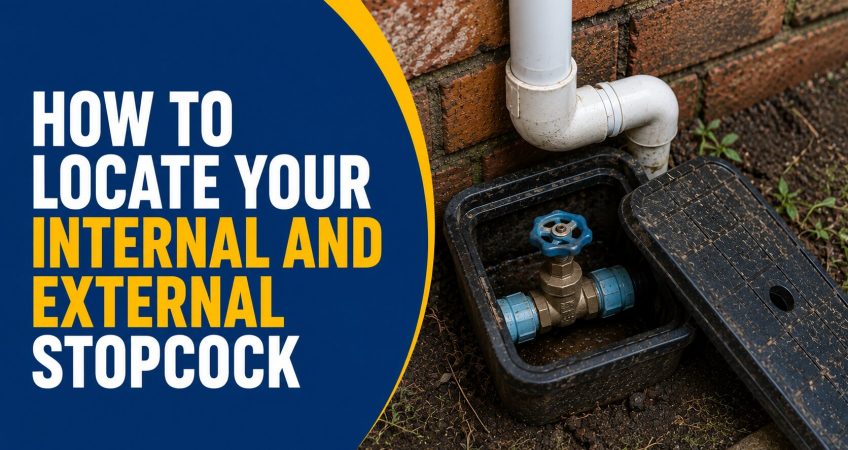
Quick answer: Your internal stopcock is most commonly found under the kitchen sink, though it can also be in an airing cupboard, under the stairs, or near the front door. Your external stop tap sits outside the property boundary, usually beneath a small cover marked “WATER” or “W.” If you’re dealing with an active leak in Essex, call us on 0800 328 2489 — we’re available 24/7 and aim to reach you within the hour.
You hear it before you see it. That unmistakable sound of water where it really, really shouldn’t be. Maybe a pipe has burst behind the washing machine, or you’ve drilled through a cold feed by mistake. Whatever the cause, the next 60 seconds matter enormously — and the difference between minor inconvenience and thousands of pounds worth of water damage often comes down to one thing: knowing where your stopcock is.
This guide will walk you through exactly how to locate your internal stopcock and external water shut off, how to use them safely, and what to do when things don’t go to plan. If you’re in Essex and it’s already an emergency, we’re on hand 24 hours a day with free call-outs and an aim to be with you in about an hour.
Where stopcocks are usually found in UK homes
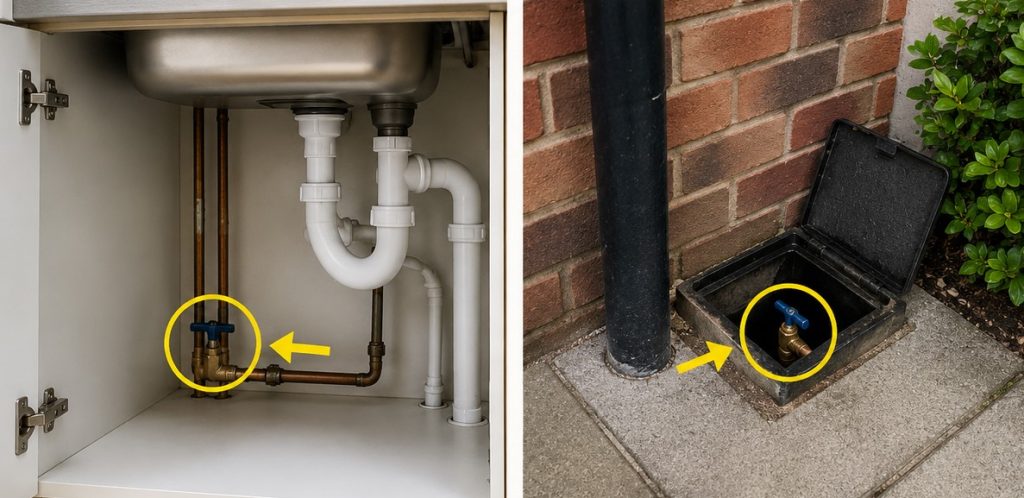
Before getting into the detail, here’s a fast reference list for the most common internal stopcock locations:
- Under the kitchen sink — the most likely spot in older properties
- Downstairs bathroom or toilet — near the basin or toilet cistern
- Utility room — often close to the washing machine or boiler
- Under the stairs — especially in terraced houses
- Near the front of the property — close to where the mains pipe enters the building
- In flats — check the hallway cupboard, or ask about the communal riser (more on this below)
Can’t spot it in any of these places? Don’t panic. Read on.
How to locate your internal stopcock step by step
The internal stopcock — also called a stop tap or stop valve — looks like a small tap without a spout. It’ll have either a round wheel handle or a flat lever, and it sits inline between two pipes, acting as a connector.
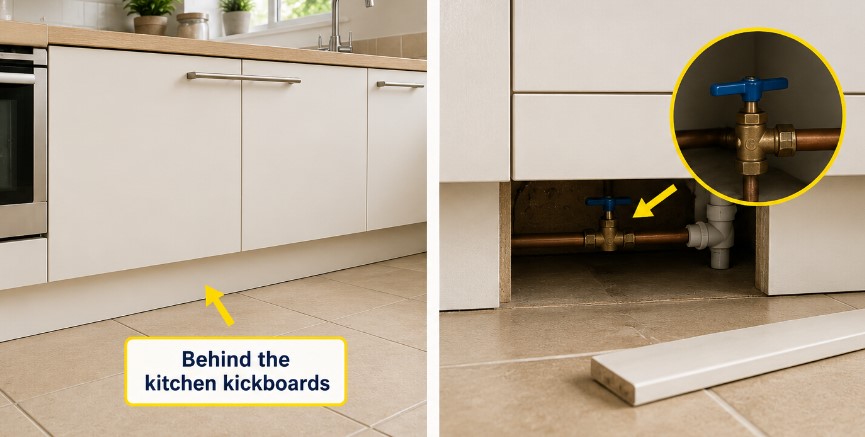
The best way to track it down is to follow the cold water pipe from where the mains supply enters your property, usually through the front wall or floor near the kitchen. Trace the pipe and you’ll generally find the stopcock within a metre or two of entry.
A few practical tips that actually help:
- Get a torch — stopcocks are almost always tucked into dark corners
- Clear out the clutter — that cupboard under the sink is often a black hole of cleaning products and carrier bags; move them out of the way
- Check behind kitchen kickboards — some properties have the valve boxed in at floor level
- Look for valves that have been painted over — a common issue in older homes, where layers of paint can make the handle hard to spot or turn
- Check the airing cupboard — particularly in homes built from the 1970s onwards
If you’ve looked everywhere and still can’t find it, don’t stress. It happens more often than you’d think, especially in older or converted properties where the pipework may have been modified over the years. This is where giving us a ring can save a lot of time.
How to locate your external water shut off
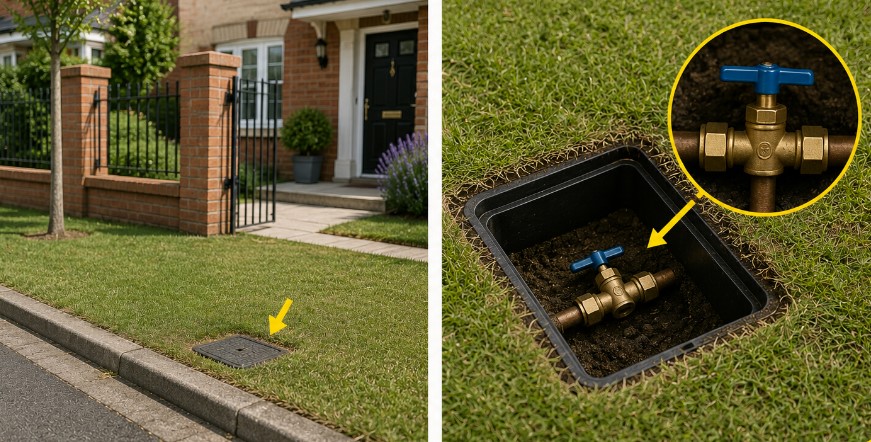
The external stop tap (sometimes called the boundary stop tap or external stopcock) is located outside your property, usually near the front boundary. Here’s where to look:
- On the pavement or footpath directly outside your home
- At the end of your driveway or within the front garden
- In the same chamber as your water meter — if you have a meter box, the external stop tap is often right next to it
- Embedded in a grass verge at the front of the property
- At the end of the road, if you’re on a shared supply (more common in older terraced streets)
You’ll recognise it by a small square cover — roughly the size of a CD case, about 150mm across — made from plastic or metal, and usually marked with the word “WATER”, “STOPCOCK”, or just the letter “W”.
To open it safely: use a flathead screwdriver to lift the cover, shine a torch inside, and use either a universal stop tap key or, if it’s a modern plastic quarter-turn valve, your hands. You can buy a stop tap key from most hardware shops for a few pounds — it’s worth keeping one in the house. Turn the valve clockwise to shut the water off, anti-clockwise to turn it back on.
Important note: the external stop tap technically belongs to your water supplier, and in some cases you may need permission to operate it — especially if you’re on a shared supply that feeds neighbouring properties too. If you’re unsure, call your water company directly.
Internal vs external: which one should you use in an emergency?
Use the internal stopcock first. It’s quicker to access, it only affects your property, and you don’t need any tools. In the vast majority of emergencies, the internal stop tap is the right call.
The external stop tap is a backup — useful when the internal one is seized, inaccessible, or if the leak is on the supply pipe between the two valves. It’s also necessary when the internal valve has failed entirely.
In flats and apartments, things get a bit more complicated. Your building may have a communal internal stop valve located where the main supply enters the building — sometimes in a basement, ground-floor riser cupboard, or near the front entrance. Your flat may also have its own individual isolation point inside or just outside your front door. If you’re unsure, check with your building management company or freeholder before touching anything communal.
How to turn the stopcock off (and back on) without making things worse
This bit matters. Here’s how to do it properly:
To turn the water off:
- Turn the valve clockwise — slowly
- Keep turning until you feel firm resistance (don’t over-tighten)
- Open a cold tap downstairs to drain residual pressure from the system
To turn the water back on:
- Close the tap you opened
- Turn the stopcock anti-clockwise — gradually
- Let the system repressurise slowly to avoid water hammer (that banging sound in the pipes)
- Check around the valve itself for any drips or weeping around the gland nut
The key word throughout is slowly. Jerking the valve open or shut is one of the most common ways to cause more damage. If at any point it feels like the valve might break, stop and call a plumber.
Common problems (and when to call us)
Here’s where things can go sideways. Real-world stopcocks — especially in older UK homes — are not always cooperative.
Stopcock won’t budge: If it’s seized, do not try to force it with brute strength. Plumbing fittings are made from brass and copper, not steel, so they won’t rust — but they do scale up with mineral deposits. More importantly, forcing the handle can snap the spindle clean off, at which point you’ve lost the valve entirely. And please don’t reach for the WD-40 — it’s designed for rust, and it won’t help here. It’ll just make the handle slippery and frustrating to work with.
Valve turns but water keeps running: This usually means the internal washer has failed. The stopcock needs replacing.
Handle snaps off: Fairly common with older brass fittings. Call a plumber.
Valve is boxed in or inaccessible: If someone’s tiled over it or built a cupboard in front of it, it needs to be relocated. Again, a job for a professional.
External stop tap buried, jammed, or missing key: If the external valve is corroded solid, you’ll need to contact your water company — they’re legally obliged to respond to emergencies within 24 hours, though that’s a long time if water’s actively flowing.
If you’re in Essex and you’ve hit any of the above, we’re here. Our team is available around the clock, call-outs are free, and we aim to be with you within the hour. Call 0800 328 2489.
Flats, new builds, and weird setups
UK plumbing doesn’t always follow the rules. Here are a few scenarios worth knowing about:
Flats: You may have an individual stop valve inside your flat (often in a hallway or bathroom cupboard), plus a communal valve in a shared riser. Always use your individual valve first. If you need to use the communal one, warn your neighbours — it will cut off their water too.
New builds: These tend to have clearer setups, with meter boxes and modern isolation valves that are easier to find and use. Still worth locating it before you need it, though.
Rural or older properties: Some have unusual arrangements — private supplies, pump systems, or old gate valves rather than modern quarter-turn isolators. If in doubt, get a plumber to walk you through your setup before an emergency arises.
Preventative tips: small things that save big headaches
- Label it. A bit of masking tape or a luggage tag on the handle takes 30 seconds and saves enormous stress in an emergency
- Keep access clear. Don’t stack things in front of or on top of the valve
- Buy a stop tap key. Keep it somewhere obvious — not in the same cupboard as the stopcock, ideally
- Test it twice a year. Turn it off and on gently; it keeps the mechanism from seizing up and confirms it’s still working
- Consider upgrading to a lever valve if yours is an old wheel-head type — we can swap it out for you, making it much easier to operate in a hurry
Frequently asked questions
How do I find the stopcock in a UK home?
Start under the kitchen sink — that’s where it is in most UK homes, particularly older properties. If it’s not there, check the airing cupboard, under the stairs, the utility room, or near where the water main enters the house. Following the cold water pipe from its entry point into the property is the most reliable method.
Where is the internal stopcock location in a typical terraced house?
In terraced houses, the internal stopcock is very commonly found under the stairs cupboard or under the kitchen sink. Because terraced properties often share a supply pipe, the external stop tap is frequently located on the pavement or shared footpath at the front of the terrace — and turning it off may affect neighbouring properties.
What if my internal stopcock won’t turn?
Don’t force it. Stopcocks are made from brass or copper, which scale up rather than rust. Applying too much torque can snap the spindle and destroy the valve entirely. Avoid WD-40 (it won’t help with scale build-up). Call a plumber who can assess whether it can be freed safely or needs replacing.
How do I use an external stop tap key?
Lift the cover using a flathead screwdriver, shine a torch into the chamber, insert the stop tap key over the valve stem, and turn clockwise to close. If it’s a modern plastic quarter-turn valve, you may be able to use your hand. Keys are widely available from hardware shops and plumbing merchants.
Do flats have an external water shut off, or is it shared?
Most flats share an external stop tap with other units in the building — turning it off cuts water to multiple properties simultaneously. Your flat may also have its own internal isolation valve inside or just outside your front door. Always use your individual valve first. For anything communal, contact your building management.
Which way do you turn a stopcock to turn the water off in the UK?
Clockwise to close (off), anti-clockwise to open (on). A useful memory aid: “righty tighty, lefty loosey.” Always turn slowly and stop when you feel firm resistance — no need to over-tighten.
Why is water still running after the stopcock is off?
If the stopcock appears to be fully closed but water keeps flowing, the internal washer has likely failed and the valve is no longer sealing properly. This is a fairly common issue in older properties. The stopcock will need to be replaced — not a DIY job if you can’t isolate the supply from outside.
Can I replace a stopcock myself, or should I call a plumber?
Replacing a stopcock requires isolating the water supply from the external stop tap first. If your external valve is working and you’re confident in basic plumbing, it’s technically possible as a DIY job. That said, getting it wrong can cause a significant water leak, so most homeowners opt to call a registered plumber. We’d always recommend a professional for any work on the mains isolation point.
When to call a plumber
Sometimes the right move is to step back and get the professionals in. That’s particularly true if:
- There’s an active leak or burst pipe and you can’t isolate the water
- The stopcock is seized, leaking, or won’t shut off fully
- The valve is inaccessible or needs relocating
- You live in a multi-occupancy building and aren’t sure about the shared supply
- The stopcock has broken in the process of trying to use it
We’re ALK Emergency Plumbers, a gas safety registered team covering Essex and the surrounding areas 24 hours a day, 7 days a week. Call-outs are free, and we aim to reach you within an hour of calling. Whether it’s the middle of the night or a Sunday afternoon, we’ll be there.
Call us or get a free quote today.